Short read
How much screen time is okay for kids? Screen time by age, as per the IAP and WHO
If you have ever wondered whether your child is watching “too much”, you are asking the right question. Here is what Indian and global child-health guidelines say, age by age, and how to act on it without turning your home into a battlefield.
The short answer: screen time by age
The Indian Academy of Pediatrics (IAP) published its screen time guidelines in 2022. They match the World Health Organization’s advice for young children closely. This is recreational screen time: cartoons, videos, games and social media, not online classes or homework.
| Age | Recreational screen time | Good to know |
|---|---|---|
| Under 2 years | None, including TV playing in the background | Don’t use screens to feed or calm. Talk, sing, read and play on the floor. |
| 2 to 5 years | Up to 1 hour a day, in sessions of 20–30 minutes. Less is better | Watch together. Choose educational, non-violent, preferably interactive content. |
| 5 to 10 years | Under 2 hours a day, the less the better | Learning comes first. No screens at meals or in the hour before bed. |
| 10 years and up | Balance, not a fixed number | If screens cut into sleep, activity, study or family time, reduce. Keep devices out of bedrooms and talk about online safety. |
What counts as screen time?
Every screen that is on for entertainment counts: phone, tablet, TV and laptop, including the TV that is “just on in the background”. In many homes, school lives on WhatsApp and online classes are real, so it helps to separate school use from leisure use. Children accept limits more easily when the rules feel fair.
The rules the guidelines agree on
- Screen-free times: meals, and the last hour before bed.
- Screen-free places: bedrooms and the dining area.
- Parents go first: children copy what we do, so make the plan for every family member, adults included.
- Quality and company: choose good content and watch with young children when you can. A large review linked co-viewing with better language skills.
- Protect the big three: sleep, physical activity and real conversation come first. Screens fit around them.
How much sleep does my child need?
Sleep is often the first thing screens push out. Portable devices at bedtime are linked to shorter and poorer sleep in children. Sleep experts recommend, per 24 hours:
- 1–2 years: 11–14 hours, including naps
- 3–5 years: 10–13 hours, including naps
- 6–12 years: 9–12 hours
- 13–18 years: 8–10 hours
Is screen time really that harmful?
Screens are not poison, and some headlines go too far. For teenagers, large studies find the link between screen use and well-being is small on average. What matters most is what screens push out of the day: sleep, outdoor play, movement and conversation. Outdoor time also protects eyesight. In one large trial, an extra 40 minutes outside at school every day reduced new short-sightedness.
Three small steps to start this week
- Watch and write. For one normal day, note every time a screen is on, for how long, and what was happening just before. Don’t change anything yet.
- Start a charging basket. All phones and tablets, grown-ups’ included, go into a basket outside the bedrooms an hour before your child’s bedtime.
- Make one meal screen-free. Start with the easiest one, then add the others over the week.
When to get help
Talk to your child’s paediatrician if your child can’t cut down despite real effort, if games or videos come before food, sleep, school and friends, and it continues even when it clearly causes problems. The WHO uses these features, usually over 12 months, to describe gaming disorder. In India, NIMHANS in Bengaluru runs the SHUT Clinic for healthy use of technology, and Tele MANAS offers free mental-health support on 14416.
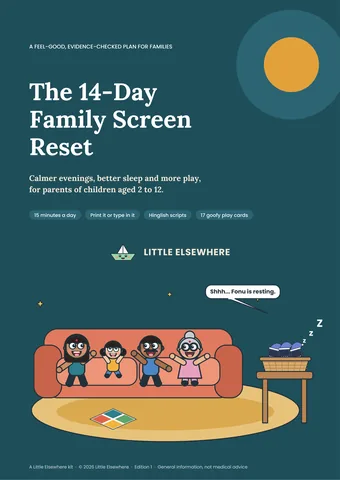
Want the whole plan, one day at a time?
The 14-Day Family Screen Reset: a 45-page illustrated PDF with daily steps, Hinglish scripts, printables and 17 screen-free play cards. ₹599, paid online, instant download.
See the kit ₹599General information for healthy families, not medical advice. If you are worried about your child’s development, eating, sleep, mood or safety, please speak to your child’s doctor.
Sources
- Gupta P, Shah D, Bedi N, et al. Indian Academy of Pediatrics Guidelines on Screen Time and Digital Wellness in Infants, Children and Adolescents. Indian Pediatrics 2022;59:235–244. www.indianpediatrics.net
- World Health Organization. Guidelines on physical activity, sedentary behaviour and sleep for children under 5 years of age. 2019. www.ncbi.nlm.nih.gov
- World Health Organization. Guidelines on physical activity and sedentary behaviour for children and adolescents aged 5–17. 2020. www.ncbi.nlm.nih.gov
- Paruthi S, et al. Recommended Amount of Sleep for Pediatric Populations: consensus statement of the American Academy of Sleep Medicine. J Clin Sleep Med 2016. jcsm.aasm.org
- American Academy of Pediatrics. How to Make a Family Media Plan. HealthyChildren.org. www.healthychildren.org
- Madigan S, et al. Associations Between Screen Use and Child Language Skills: a systematic review and meta-analysis. JAMA Pediatrics 2020. jamanetwork.com
- Carter B, et al. Association Between Portable Screen-Based Media Device Access or Use and Sleep Outcomes: a systematic review and meta-analysis. JAMA Pediatrics 2016. kclpure.kcl.ac.uk
- Orben A, Przybylski AK. The association between adolescent well-being and digital technology use. Nature Human Behaviour 2019. www.nature.com
- He M, et al. Effect of Time Spent Outdoors at School on the Development of Myopia Among Children in China: a randomized clinical trial. JAMA 2015. jamanetwork.com
- World Health Organization. Addictive behaviours: Gaming disorder (questions and answers). www.who.int
- NIMHANS. Service for Healthy Use of Technology (SHUT Clinic). www.nimhans.ac.in
- Ministry of Health and Family Welfare. Tele MANAS, national tele-mental health helpline 14416. telemanas.mohfw.gov.in