
Short read
“Cartoon lagao, khana khilao”? How to feed your toddler without a mobile
A cartoon on the phone, a spoon going in while the child stares at the screen. In many homes this is how meals happen, especially with toddlers. It works in the moment. Here is why it is worth changing, and how to do it without daily fights.
Why doctors say no screens at mealtimes
The Indian Academy of Pediatrics says plainly that screens should not be used to help feed a child, or as an easy way to calm one. Mealtimes are also some of the best talk time a family has: children learn words and conversation from the people around them, not from the cartoon. And in a 2023 study of 422 children aged 3 to 5, using a device to calm them down was linked to more emotional outbursts later, especially in boys. The researchers suggest one reason: the phone may take away chances to learn how to settle themselves.
Seven gentle tips
- Eat together. Sit down with your child and eat your own food at the same time. Children copy what they see.
- Let them touch and self-feed. Small, soft pieces: roti, idli, well-cooked vegetables. Keep them sitting up, and stay with them while they eat. It will be messy. That is part of learning.
- Keep meals short. Serve small portions and end the meal calmly when your child is done, rather than chasing every last bite.
- Play table games instead of cartoons. “Three good things today”, name every colour on the plate, or guess the sabzi with eyes closed.
- Warn before the meal. “Five minutes, then khana.” Switching off a screen mid-video is where most tantrums start.
- Expect a few fussy meals. Any change of routine brings some protest, and the first few days are usually the hardest. Give it a full week before you judge.
- Get every adult on board. If Dadi or the didi still plays cartoons at lunch, the rule won’t stick. Share the plan and give them alternatives.
A one-week switch plan
- Day 1: just notice. Which meals have a screen, and what happens when it goes off?
- Days 2–3: make the easiest meal (often breakfast) screen-free.
- Days 4–5: add dinner, with the table games.
- Days 6–7: all meals, every adult. Celebrate the small wins.
What to say to grandparents and helpers
To Dadi or Nani: “Aapka pyaar aur time uske liye sabse zaroori hai. Bachchon ke doctors kehte hain ki khana khilate waqt phone nahi. Aap kahani sunaiye, woh aapse bahut kuch seekhega.”
To the didi or nanny: “Didi, khana khilate waqt TV aur phone nahi. Ye games karwaiye: plate ke colours ginna, teen achhi baatein.”
What if my child refuses to eat?
Eating a little less for a meal or two is common while a habit changes. Stay calm and consistent, and do not bring the phone back to get one more bite in. If you are worried about your child’s weight, growth or eating, or meals are a struggle for weeks, talk to your paediatrician.
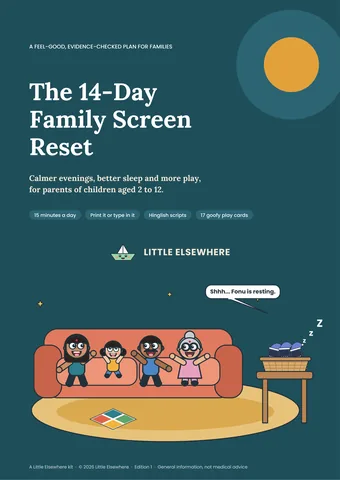
Want the whole plan, one day at a time?
The 14-Day Family Screen Reset: a 45-page illustrated PDF with daily steps, Hinglish scripts, printables and 17 screen-free play cards. ₹599, paid online, instant download.
See the kit ₹599General information for healthy families, not medical advice. If you are worried about your child’s development, eating, sleep, mood or safety, please speak to your child’s doctor.
Sources
- Gupta P, Shah D, Bedi N, et al. Indian Academy of Pediatrics Guidelines on Screen Time and Digital Wellness in Infants, Children and Adolescents. Indian Pediatrics 2022;59:235–244. www.indianpediatrics.net
- American Academy of Pediatrics. How to Make a Family Media Plan. HealthyChildren.org. www.healthychildren.org
- Radesky JS, et al. Longitudinal associations between use of mobile devices for calming and emotional reactivity and executive functioning in children aged 3 to 5 years. JAMA Pediatrics 2023. pubmed.ncbi.nlm.nih.gov
- Madigan S, et al. Associations Between Screen Use and Child Language Skills: a systematic review and meta-analysis. JAMA Pediatrics 2020. jamanetwork.com